
The Challenge:
Democratize Business Valuation
Business valuation is as cumbersome as it is important to business owners.
BizEquity’s mission is to offer an accurate online valuation that is accessible to small business owners. Traditional business valuation methods are expensive and time consuming, creating a barrier for small business owners to know what the value of their largest asset.
High Level Goals
1. Make information accessible
2. Reduce cost and time
3. Provide a valuation that is useful & accurate
My Role
I designed the user experience, the UI framework, and the front-end for the entire project. I worked closely with the CEO being the primary stakeholder, a project manager, and the CTO. Once the design was developed and iterated on, I passed the back-end work on to the development team.


Discovery
Starting a transformation
The previous version of BizEquity’s online valuation platform was built primarily as a proof of concept and a way to simply visualize the algorithm. Users were a secondary concern in the creation of the original tool.
The valuation process is inherently complicated and the platform needed to be transformed to actually guide the users towards their goals in a useful and satisfying way.
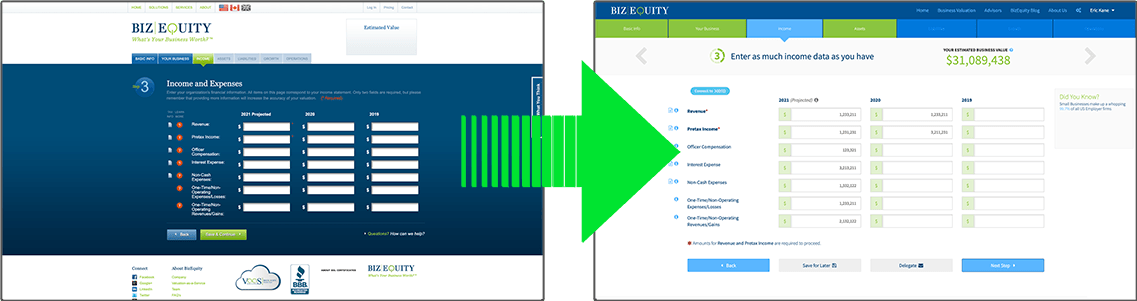
Finding the pain points in the current process
By gathering insights from early adapters and offering the valuation service for free to the public I was able to discover what was preventing users from reaching their goals. Through observing users in the environment where they typically used the app as well as directly soliciting feedback I gathered insight into where our system could improve.
The following issues were found to have lead to significant drop off in completion of the valuation:
- Being overwhelmed due to number of form fields
- Unfamiliarity with the financial information being requested
- Lack of a sense of progress
While financials are not the most exciting of subject matters, they are a vital part of running a business. We found that the most readily accessible and already familiar information for small business owners was that of their tax forms.

The important step of gathering requrements from stakeholders, while advocating for the needs of the user.
Design
Iterating to the solution
Keeping in mind the business goals, the user needs, and the findings of the previous discovery, I set to design the UX for the online valuation process.
It was important to guide the user through the process without overwhelming them. This could be mitigated with the following:
- Show immediate feedback
- Convey a sense of progress
- Provide easy access to deeper explanations/concepts
Wireframing to map out the user flow and provide a basis for producing organizing content along with detailed copy. With the complexity and the large amount of input fields involved in feeding the valuation algorithm, it was necessary to

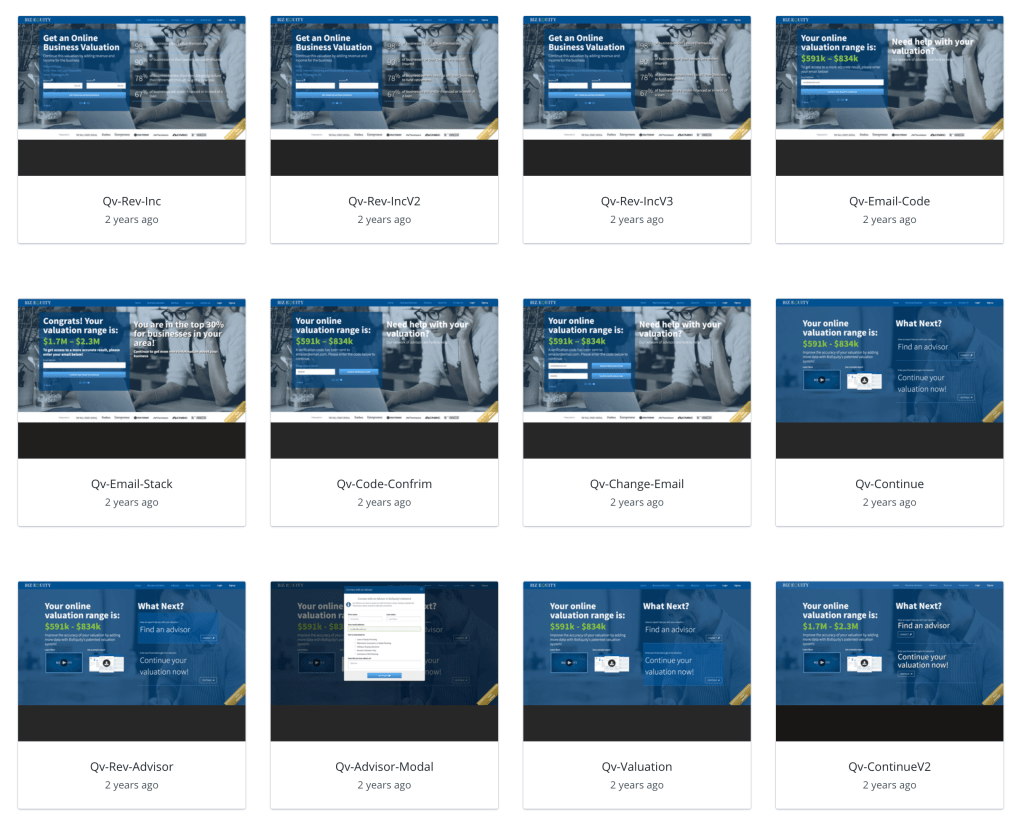
Prototyping to explore options for the entry points into the valuation process.
We found in our iterations of the steps within the valuation that users completed the form fields that are needed at baseline for a valuation when we separated them out and gathered them up front. If we were able to gather: industry, location, revenue, and income we could give a valuation estimate range immediately. The remaining process would then clearly refine and provide a more accurate valuation. Using a prototype I was able to present the different options to the stakeholders and development team and get feedback to decide which versions to A/B test.
Building the UI for something heavy on forms/inputs can be tricky. Informed by all the parts of the previous design processes I brought a lot of elements together to make sure that the users were guided through the information as smoothly and informed as they could be. Different users use this app in different ways and the following solution offered them ways to engage with the steps with whatever depths their needs took them.
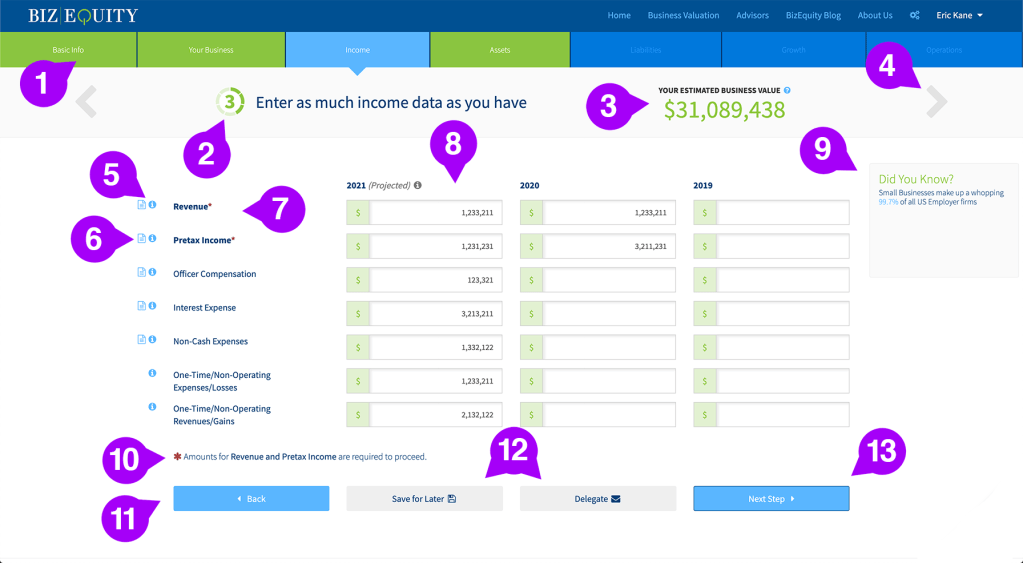
- Tabs show progress through the steps by previewing categories and color coding status (completed, in progress, incomplete).
- Title indicates current step and prompts information needed for entry in the form.
- Valuation is shown prominently and responds to form field inputs by actively rolling the number up or down in a real time calculation.
- Navigation retains its position on the page to eliminate the need to scroll to navigation buttons within the form.
- Financial information title with icon mouse over for detailed definition.
- Tax information is revealed on mouse over. The information and layout dynamically maps the tax form the user is referencing.
- Required fields are indicated with bold text and icon, see #10 for indicator and error display.
- Form fields are provided for three years of data entry. The current year is projected to include for scenario planning.
- Facts about the user’s business and industry based on their inputs. Will give general tips or indicators on how the business is performing relative to industry average.
- Error indicator and required fields list. The row will highlight to draw attention.
- Navigation controls easily accesible after form is completed.
- Save option for bookmarking their progress within the valuation steps to finish later. Additionally there’s the option to delegate their valuation to be completed by an third party that saves their progress as well.
- Next step button will change status of the form. If required fields are missing, the error text will instruct them on how to continue.
Results
As the core product for BizEquity, the valuation process saw usage more than double nearly immediately and it has been the basis for small business owner subscriptions for the service. This valuation process that I designed has also been adapted for greater use as a white-labeling service to BizEquity’s financial advisor client base which holds an 87% retention rate currently.
 Eric Kane